

falktx @falktx@mastodon.falktx.com
falktx
boosted

Hello, world!
Following recent changes at Twitter, the new home of the X.Org Foundation is here on Mastodon. Please follow for the latest in the Linux graphics world and the freedesktop.org community. Going forward, we will no longer post to Twitter, but we're so excited to join the Fediverse!
and it should work on Chrome now too!
on the topic of running things on the browser, who wants some LV2 plugins?
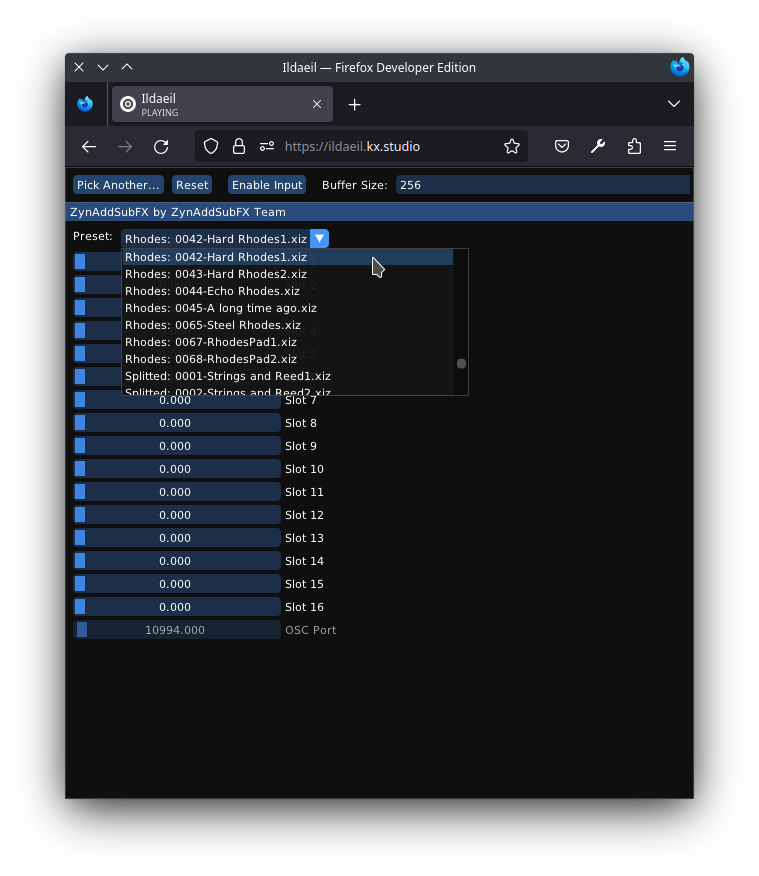
let's say in between some of them ZynAddSubFX? 😱
No UI for now, just the engine and a selection of presets, playable through WebMIDI.
Some throw an exception when loaded, but most seem to work
Also I need to handle MIDI timing properly...
That said:
1. Load https://ildaeil.kx.studio/ in Firefox (Chrome not supported)
2. Select ZynAddSubFX, press "Load Plugin"
3. Press "Enable MIDI"
4. Select a preset and play
Enjoy? 😅
Cardinal on the web randomly got some attention via
https://news.ycombinator.com/item?id=35794758
So I wonder how many people out there still do not know this is a thing...
The full Cardinal (basically a more free version of VCV Rack, with all modules built-in) running directly on a web browser at https://cardinal.kx.studio/
I recently updated it so that on browsers that dont support wasm-simd (webkit-based ones like Safari) will load a slower but still compatible variant.
So in theory it works under iOS, didnt test.
falktx
boosted
"We're building a great open future, if you want yo help us, just join our discord".
I'm really wondering what the terrible, non-open future looks like.
falktx
boosted

falktx
boosted

In preparation for the release of #TDE R14.1.0 this Sunday, we have reworked our screenshot webpage. Check out what #Trinity can look like at https://www.trinitydesktop.org/screenshots.php.
More screenshots from our community members are also available at https://wiki.trinitydesktop.org/Community_Screenshots.
falktx
boosted

We've just released Ardour 7.4 with bugfixes and several new features: MIDI subgroup busses, volume control for the clip picker, optional neutral color for new tracks & busses, a Lua script to downmix 5.1 to stereo, and more.
Release notes: https://ardour.org/whatsnew.html
Downloads: https://ardour.org/download.html
falktx
boosted

To make anyone of you go ballistic on how bad this currently looks, put it into context to what current-gen Qualcomm smartphones are doing:
https://www.theverge.com/22811740/qualcomm-snapdragon-8-gen-1-always-on-camera-privacy-security-concerns
A phone that calls home on hardware level with always-on mic AND cameras and the ability to analyze that data using the inbuilt NPU (Neural Processing Unit)? Oh boy, do I feel safer now.
🔥  🔥 🔥
🔥 🔥
#privacy #security #android #qualcomm #surveillance #SurveillanceCapitalism
@mic they both use the same capture and training ideas, but the engine powering the trained data is different
NAM uses WaveNet, which is known to use quite a lot of CPU.
AIDA-X uses RNN style (how they different exactly I cant say, but they are from different scientific papers and research)
Sadly the NAM plugin doesn't support Linux. :(
The LV2 port is still WIP and not too stable in my opinion.
Something that has been brewing in the last few weeks...
https://kx.studio/News/?action=view&url=introducing-aida-x
This is a (bass/guitar-focused) Amp Model Player audio plugin, basically it loads AI trained models to realistically simulate an audio effect (amp, cab, dist, drive, fuzz, boost and eq).
Available as AU/CLAP/LV2/VST2/VST3 and Standalone.
Done in partnership with AIDA-DSP and MOD Audio.
Enjoy!
I realize I should have said more details about it, let me reedit and repost, sorry!
falktx
boosted

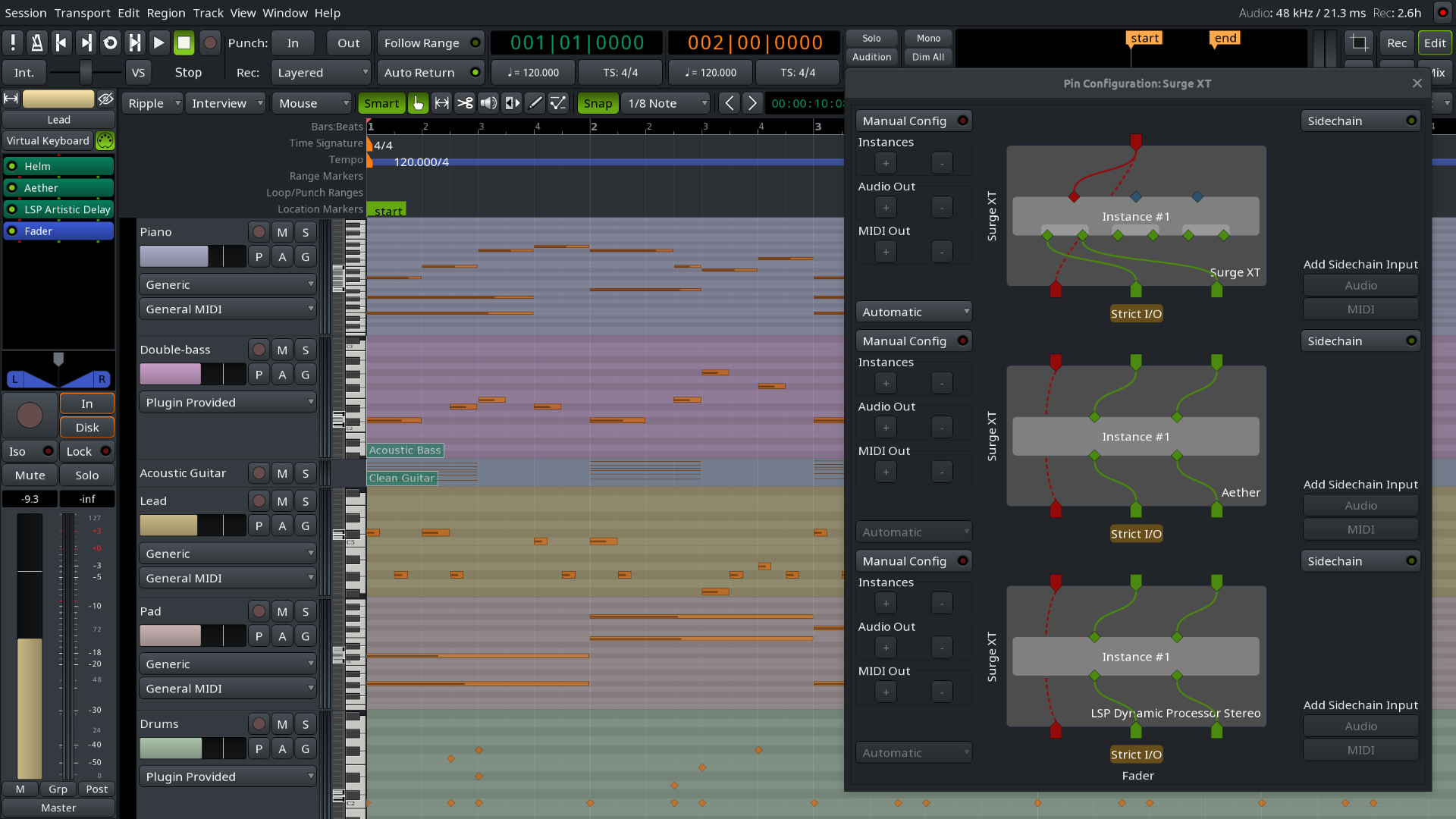

Weekly recap is out. Highlights: new releases of BeeRef's fork, Armory3D, and topologicpy, new features in @GIMP and @FreeCAD, @inkscape is looking for an experienced GTK4 developer
More on all that: https://librearts.org/2023/04/week-recap-23-apr-2023/
Featured #b3d artwork by Charlotte Kügler
@jbowen in my own way of fun, sure! https://github.com/falktx/ shows most of them
@marcan@treehouse.systems @dr2chase compilers and crashes can question our sanity in some serious ways, making us feel bad about it without (sometimes!) being our fault
my recent pain is enabling LTO causing crashes, but the same thing runs fine without LTO. even though there are no conflicting symbols anywhere... 😢
@Sobex @marcan@treehouse.systems the sound one :D
"carla plugin host" is the extended name if needed.
@marcan@treehouse.systems @dr2chase it is easier for you to say perhaps, I dont know enough about this assembler side to ever come up with a reason why something is crashing like that, so preparing a test case is impossible.
@dr2chase @marcan@treehouse.systems it is possible to build that specific part of the code with -O0 too, or to be even more verbose use
```
__attribute__((optimize(0)))
```
around the functions where the bad behaviour happens.
it is not a gcc12 specific issue by the way, for a few other cases I needed to do something similar in ARM builds.
@arcade to be honest, it is hard to keep up when web standards change faster than any reasonably full implementation can keep track of.
and specially for things that directly talk with OS/system services, there is some security considerations to take into account first.
heck, Google folks are already preparing a web-specific GL/Vulkan-like graphics API, separately from WebGL.
no reasonable team can keep up with all of this and still have a safe browsing environment
